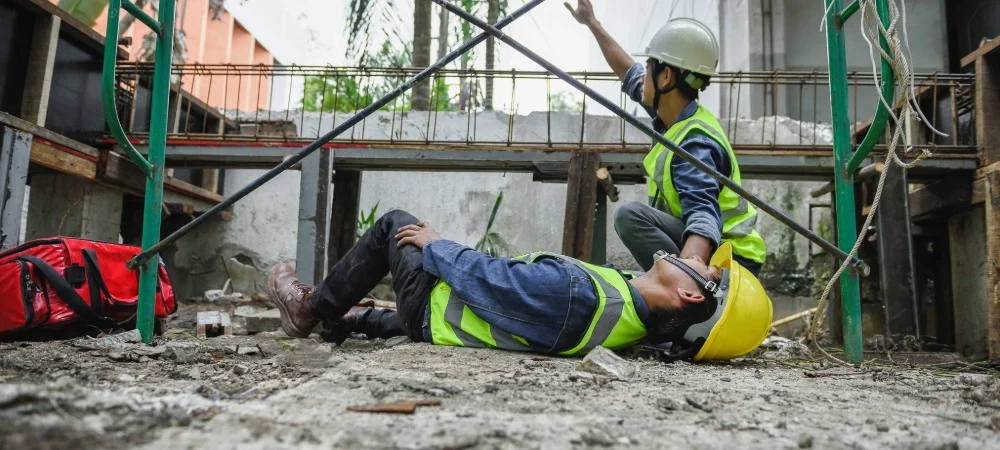
More than 2.6 million fatalities occur annually due to work-related causes, many linked to hazards that were present but not interpreted early enough. Gary Ng, CEO of viAct, discusses the growing role of automation and real-time analytics in preventing workplace incidents.
Imagine a worker briefly stepping outside a designated safe zone. At the same time, a forklift turns into a blind spot. Nothing happens at the moment– but it easily could have. No alarm is triggered, no report is filed, and by the end of the shift, the moment is forgotten.
This is how most workplace incidents begin – not as dramatic failures, but as missed signals.
Despite decades of regulatory advancement, global safety performance continues to face structural limitations. The International Labour Organization estimates that over 2.6 million fatalities occur annually due to work-related causes, many linked to hazards that were present but not interpreted early enough.
Data from the Occupational Safety and Health Administration (OSHA) further highlights that leading causes of workplace incidents – falls, electrocution, struck-by and caught-in-between to harmful environments – remain persistent across industries like construction.
What is becoming increasingly evident is that risk is dynamic, while traditional oversight remains periodic. This misalignment is now driving a fundamental shift toward automation and real-time analytics as core components of modern safety strategy.
From site monitoring to continuous risk interpretation
For years, safety systems have been built around documentation – incident reports, inspection records and compliance checklists. While essential, these mechanisms are inherently retrospective. They describe what has already happened, often after the opportunity for prevention has passed.
Automation and real-time analytics are redefining this model by introducing continuous risk interpretation.
Through the integration of AI, computer vision and connected sensors, industrial environments are increasingly being transformed into observable systems. The global AI in workplace safety market is expected to reach US$6788 million by 2030, growing at a CAGR of 18.2%.
In construction environments, this may involve identifying unsafe worker positioning or deviations in temporary structures before they escalate. In manufacturing, it can include detecting abnormal equipment behaviour that precedes mechanical failure. In energy operations, it extends to recognising patterns in environmental conditions that indicate potential exposure risks.
Automation as operational infrastructure, not overlay
As industrial operations scale in complexity, the limitations of manual supervision become increasingly pronounced. Large worksites, multi-contractor environments and continuous operations create conditions where risk signals are distributed, transient and often missed.
Automation addresses this not by replacing human oversight, but by establishing a persistent layer of observation.
This layer operates continuously, identifying deviations such as unauthorised access, unsafe proximity between workers and machinery or lapses in procedural compliance. More importantly, it does so across the entire operational environment, not just within the line of sight of a supervisor.
The implication is that safety is no longer dependent on intermittent visibility. It becomes systemically embedded within operations, supported by technologies that can process scale, complexity and variability in ways that traditional approaches cannot.
The strategic shift toward leading indicators
What automation changes most fundamentally is not just the speed of detection, but when it becomes detectable in the first place.
AI-powered camera systems monitor every corner of an operational environment simultaneously, flagging a worker who has entered a restricted zone, detecting a near-miss between a pedestrian and a moving vehicle or identifying that PPE has not been worn correctly before that worker reaches the hazard.
Each of these events, on its own, may seem minor. But automation logs every one of them – time-stamped, location-tagged and tied to the specific conditions present at that moment.
Over days and weeks, patterns emerge that no manual inspection cycle would ever catch consistently. A particular blind spot where unsafe interactions cluster. A shift window where compliance consistently drops. A piece of equipment whose proximity to foot traffic repeatedly generates near-misses.
These patterns are the earliest readable signal that an incident is forming and they are only visible because automation is accumulating and interpreting data continuously, not in snapshots.
Translating AI insight into intervention
The value of automation and analytics is ultimately determined by how effectively insights are translated into action.
In practice, this means moving beyond visibility to operational decision-making.
For instance, on the relocation sites of a Dubai power generation manufacturer, recurring near-miss incidents were observed in areas where workers and mobile equipment operated in close proximity. Traditional controls – training programmes, signage and supervision – had limited impact because they addressed the problem broadly rather than precisely.
By applying real-time analytics, the organisation was able to identify specific zones and time windows where unsafe interactions were most frequent. This enabled targeted interventions, including workflow adjustments, spatial reconfiguration and improved co-ordination between teams, resulting in 54% reduced safety violations and 71% lowered response time.
The outcome was not only a reduction in incidents, but also improved operational efficiency – demonstrating that safety improvements often align with productivity gains when driven by accurate, contextual data.
Taking the leap from AI adoption to digital discipline in 2026
The next phase of safety transformation will not be defined by access to data, but by the speed and precision with which that data is translated into action. In many organisations, a critical gap still exists between detection and response.
Real-time analytics closes this gap.
By compressing the time between identifying a risk and addressing it, automation transforms safety into an active, continuously operating function. Whether it is a worker without PPE or an unsafe behavioural action, the ability to respond instantly changes the trajectory of potential incidents.
The real value of automation in workplace safety lies in its ability to convert real-time insights into immediate, precise intervention. When organisations can act on risk as it emerges, incident prevention becomes embedded within operations – not treated as a downstream outcome.
Looking ahead, the organisations that will lead in safety are those that operationalise this capability fully – where automation and real-time analytics are relied upon to intervene continuously and decisively at the point where risk begins.
Because the forklift and the worker will occupy the same blind spot again. The only question is whether the system sees it in time.