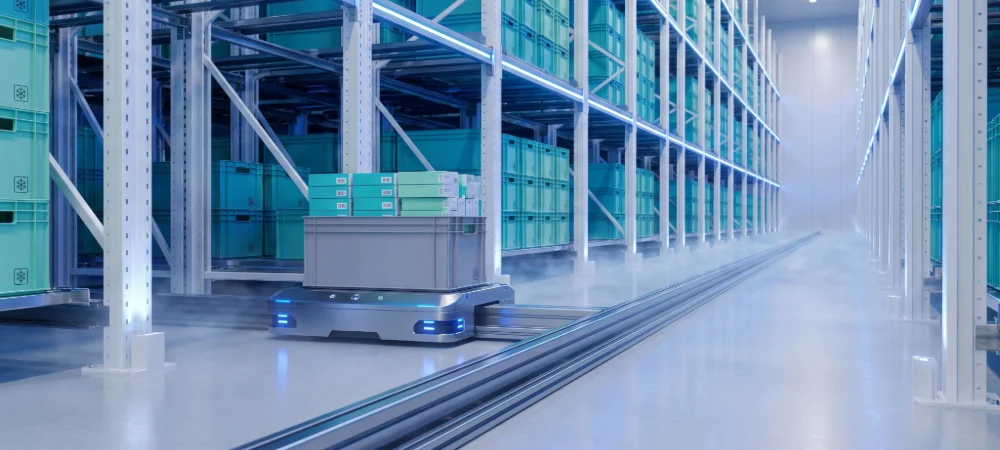
As warehouse automation advances towards increasingly autonomous operations, Samuel Bateman, Senior Associate and Patent Attorney, and Chris Froud, Partner and Patent Attorney at European IP firm Withers & Rogers, explore how emerging robotics and AI technologies could reshape fulfilment centres and why developers should consider their intellectual property strategies early.

Whilst many modern warehouses are automated to some degree or other, none can yet really be described as ‘end-to-end’ autonomous. However, recent advances in AI and robotics have shifted the dial much closer to the vision of a fully realised end-to-end automated warehouse
Most examples to emerge in recent years of warehouse automation in action have focused on fulfilling specific tasks, rather than delivering a single seamless end-to-end solution. One of the most common examples is the automated guided cart (often referred to as an ‘Autonomous Mobile Robot’ or AMR), which follows a path around a warehouse to collect or deposit items. However, this usually requires the assistance of a human operative to transfer an item to or from a shelf. The guided cart knows where the item is located or should be stowed and can travel there autonomously; however, a human is required to transfer the item. This is because the ‘picking and stowing’ of the item itself, whilst being straightforward for a human, is a more technically challenging task for an automated robot.

Last year, Amazon announced its new AI-powered ‘pick and stow’ robot, Vulcan, which has proven to be a potential gamechanger in this field, no longer requiring human intervention for ‘picking and stowing’ tasks. Its innovative manipulator system can retrieve and stow a variety of products held in existing fabric totes widely deployed in Amazon warehouses on densely packed shelves up to ceiling height, using Physical AI and force sensors which provide it with a human-like ‘sense of touch’.
Trained to recognise each item visually and manipulate them by ‘touch’, the jaws and extending plate of Vulcan’s manipulator applies just the right amount of pressure required to place each item safely in the tote, without dropping the item or damaging other items around it. Vulcan has already been recognised for its innovative approach, recently winning the 2026 RBR50 Robot of the Year Award at an event in Boston, USA.
The cost implications of implementing fully automated ‘pick and stow’ systems at scale are significant, however, particularly bearing in mind the infrastructure changes that might be required to fully optimise their efficiency. Research papers published by Amazon, following the trial of robotic systems ‘Stow’ and ‘Pick’ – precursors to Vulcan – make it clear that there is still room for improvement. The research showed that both Stow and Pick were more reliable in completing their specific tasks than human operatives, with 85% and 91% success rates respectively, but they could still do better. For example,
‘Stow’ could be faster and was only as fast as a human operative and ‘Pick’ could be better at recognising the right item more of the time, using its advanced machine vision technology.
Whilst Vulcan is designed for the specific task of picking and stowing, humanoid robots, such as Atlas developed by Boston Dynamics, provide more human-like flexibility across a range of different tasks. Suited to heavy-duty lifting, Atlas’ modular design, joint mobility and AI-enabled adaptability allows it to carry out a variety of different tasks and operations in a warehouse environment. However, such humanoid robots can be expensive and complex and can be less efficient when carrying out specific tasks compared to robots more specialised for that particular purpose.
Developers are looking to build on these advances, further enhancing robot capabilities and performance in a warehouse setting with next generation, fully automated systems that can operate independently and with minimal human interaction. For example, Locus Robotics has recently launched Locus Array, an AI-driven autonomous fulfilment system featuring mobile robotics, integrated picking arms and physical AI capability.
Locus Robotics recently filed US patent application US20260159319A1, which demonstrates an autonomous mobile robot with a ‘tote magazine’ having multiple vertically arranged slots which allow the AMR to store multiple totes, allowing the picking process to be parallelised across multiple totes simultaneously to increase the number of items that can be picked for any given journey around the warehouse. A ‘tote elevator’ allows the robot to autonomously pick and place totes at a wide range of different heights by raising and lowering the elevator, potentially allowing items to be stowed at greater heights and eliminating the time penalty and health and safety risks associated with human operators using ladders or forklifts to retrieve items from high shelves.
Combined with the picking arm described in US20260159320A1, the Locus Array AMR can work around the clock, boosting overall throughput significantly and reducing the need for manual labour.
The increasing deployment of advanced warehouse automation systems such as Amazon’s Vulcan robot and Locus Robotics’ Locus Array is likely to reshape both the size and location of future warehouses. By improving picking efficiency, increasing storage density and reducing reliance on large manual workforces, these technologies enable operators to process greater volumes within a given footprint while making greater use of vertical space.
At the same time, reduced dependence on labour availability may allow warehouses to be located further from major population centres, where land is cheaper and transport links are more important than access to workers.
For developers targeting their innovations at the fulfilment centres of the future, it is important to consider intellectual property (IP) strategy carefully. As warehouse location becomes increasingly driven by logistics infrastructure rather than labour availability, companies may deploy automated facilities in different regions and countries to optimise other factors, such as transport costs and supply chain reliability, customer service and access to low-carbon energy.
Over the 20-year lifespan of a patent, the warehouse landscape could change significantly, with automation enabling new logistics modalities centred on ports, airports, rail freight hubs and last-mile distribution centres. These shifts may create opportunities for innovations tailored to specific operating environments, while also influencing patent filing strategy, as businesses may need protection in jurisdictions where future automated warehouse networks are deployed and commercialised, rather than only in today’s key manufacturing or logistics markets.
When considering their patent strategy, innovators should consider these potential changes over the full lifetime of a patent and follow an IP strategy that will enable them to adapt and capitalise on market changes in the future.