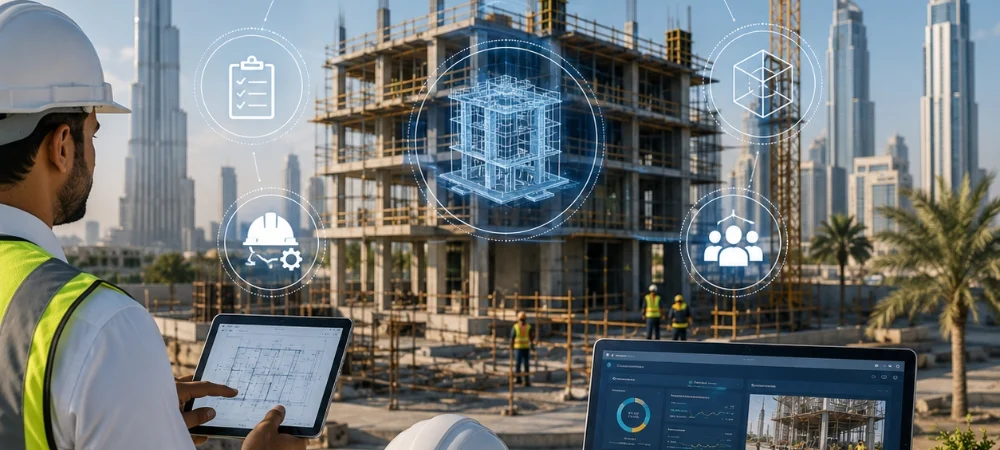
Ibrahim Imam, Co-Founder and Co-CEO of PlanRadar, explores how digital technologies are helping construction teams across the UAE improve decision-making, reduce rework, strengthen sustainability and deliver smarter, more resilient projects.
In 2026, Dubai Municipality announced a global challenge to construct the world’s first residential villa built entirely using robotic construction systems. The initiative comes as construction technology adoption accelerates worldwide, with investment in the sector projected to exceed US$30 billion by 2033.
Digital Transformation in construction is no longer optional. Technology is reshaping how projects are planned, tracked, coordinated and handed over. More importantly, it is enabling project teams to identify risks earlier and move from reactive problem-solving towards proactive, data-informed decision-making.
As this shift gathers pace, Ibrahim Imam, CEO and Co-founder of PlanRadar, outlines five ways technology is enabling smarter construction across the UAE.
Digitising traditionally manual construction workflows
Construction has historically relied on manual processes, with documentation managed through paper forms, spreadsheets, emails and messaging apps. These fragmented workflows can slow decision-making and increase the risk of information being lost, duplicated or overlooked. Globally, poor data management and miscommunication are estimated to cost construction companies up to US$1.8 trillion annually.
Digital tools are changing this by bringing core site workflows into connected platforms. Tasks can be created, assigned, tracked and updated in real time, while photos, plans, comments, checklists and reports can be linked to specific locations, units, floors or project stages. This makes information easier to access, verify and act upon. Across project types and regions, rework can account for between 1% and 20% of total project costs. By digitising workflows, project teams can identify and resolve issues earlier, improve first-time quality and spend less time searching for information
Enabling more data-driven decision-making throughout the project lifecycle
Construction projects generate large volumes of data. However, this data is only valuable if it is captured accurately, organised properly, and made available to the right people at the right time. With profit margins on mid-to-large-scale UAE construction projects hovering between 8% to 12% and tender price inflation steadily rising, contractors cannot afford blind spots. When information is stored across disconnected systems, project leaders may only recognise recurring quality issues, schedule risks or resource bottlenecks after they have already eroded these tight margins.
Digital platforms help turn project information into usable insight. By centralising data from site activities and project workflows, teams can identify trends, monitor performance, and make decisions based on evidence rather than assumptions. For example, repeated defects in a specific zone can indicate a subcontractor issue, frequent delays in inspections can highlight a resource gap and unresolved tasks across multiple sites can signal a wider coordination challenge. This data-driven approach supports better planning and risk management, allowing senior leaders to move from retrospective reporting to early intervention.
Supporting smarter and more sustainable cities
The UAE’s smart city ambitions are raising expectations for how buildings are designed, constructed and operated. The UAE Net Zero 2050 Strategy places energy efficiency and sustainable building practices at the centre of the country’s transition. At the local level, all new buildings in Dubai must meet the mandatory requirements of the Al Sa’fat Green Building System, while Abu Dhabi’s Estidama Pearl Rating System sets sustainability standards for buildings, villas and communities.
To accelerate innovation in construction, the government also launched the Dubai 3D Printing Strategy, which aims for 25% of new buildings to incorporate 3D printing technologies by 2030, helping reduce construction waste and reliance on manual labour. Digital construction platforms support these ambitions by enabling teams to track sustainable materials, document inspections, monitor waste, assign corrective actions and maintain a clear digital record of compliance throughout the project lifecycle.
Connecting design and construction through BIM
Building Information Modelling, commonly known as BIM, creates a shared digital model of a building’s architectural, structural, and mechanical systems. It enables architects, engineers, contractors and developers to work from one coordinated source of information.
By supporting accurate visualisation, clash detection and better coordination between trades, BIM can reduce rework, delays and unexpected costs. In Dubai, its use is becoming more embedded through Dubai Municipality’s engineering excellence criteria, automated design reviews, smart inspections and integration with geospatial data. As building complexity increases, mandating centralised BIM workflows ensures that data loss between the design phase and the physical construction phase is minimised
Extending building intelligence through digital twins
A digital twin is a dynamic virtual representation of a physical building, infrastructure asset, or wider urban environment. Unlike a static model, it can be continuously updated using information from sensors, building management systems and other operational sources.
Dubai is already applying this technology at a massive scale. The Dubai Digital Twin Platform, championed by Dubai Municipality, has mapped 3D models of more than 195,000 buildings, 330,000 public facilities and 280,000 infrastructure assets. This centralised virtual replica allows city planners and facilities teams to monitor energy use, assess equipment performance, simulate rainfall and emergency scenarios and test different operating scenarios before making physical changes.
Smarter construction is not driven by one technology, but by how effectively different tools work together. Digital documentation creates a reliable record of project activity, data platforms support faster decisions, green building frameworks define measurable performance targets, BIM improves coordination and digital twins extend insight into building operations.
As the UAE advances its smart city and sustainability ambitions, construction companies will need to integrate these tools across the full project lifecycle. Those that do will be better equipped to reduce rework, strengthen compliance, improve asset performance and deliver more efficient, resilient and future-ready buildings.