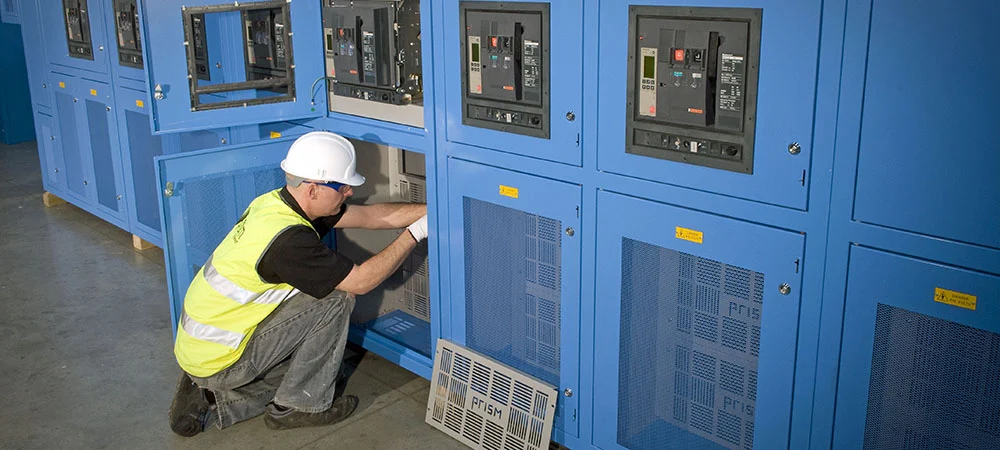
Adhum Carter Wolde-Lule, Director at Prism Power Group, explores how mounting switchgear shortages driven by data centre expansion and electrification are reshaping UK commercial construction timelines, procurement strategies and project risk.
Switchgear is fast becoming one of the biggest hidden constraints in UK commercial construction, yet it barely features in the wider debate about AI, net zero or infrastructure growth.
So says Prism Power, a leading supplier, which is seeing the issue daily – with lead times once predictable now stretching into many months and manufacturers inundated with data centre orders. Commercial building projects, including offices, mixed-use schemes, logistics hubs and healthcare facilities, are increasingly finding themselves pushed down the queue.
With data centres absorbing enormous volumes of low- and medium-voltage switchgear, alongside AI workloads, hyperscale cloud expansion and government backing of digital infrastructure, demand has shifted into a different gear entirely.
Adhum Carter Wolde-Lule, Director at Prism Power Group, said: “Manufacturers are simply behaving rationally. If you are allocating factory capacity and you have a 50MW data centre framework on one side and a standalone commercial building on the other, the decision is straightforward. Scale and certainty win.
“Commercial projects are now operating in a market where they are no longer the priority customer. We are seeing selective quoting, with some manufacturers choosing not to price lower-value packages at all. Validity periods are shrinking. Deposits are increasing. High-value or repeat projects are favoured, while one-off commercial schemes struggle to secure firm commitments.”
One of the biggest problems is that too many programmes are still built on outdated assumptions. Switchgear is no longer a late-stage procurement item that can be slotted in once the design is largely complete. It has become a critical-path risk requiring early design freeze and early engagement with manufacturers. Leave it too late and commissioning windows collapse, temporary power arrangements become extended, redesign pressure increases and cost certainty evaporates.
More concerning is the compliance risk that emerges when projects are under pressure. When timelines compress and options narrow, teams start looking for what is available rather than what is engineered correctly for the application. Substitutions become reactive. Approvals are rushed. Non-standard configurations enter the conversation. Electrical infrastructure is not decorative; it is the safety backbone of the building. You cannot value-engineer resilience out of it without consequence.
There is also a broader market distortion taking place. When manufacturers prioritise large repeat buyers – understandably drawn to the hyperscale data centre sector – SMEs and regional contractors are squeezed. They either price in significant risk premiums or decline to tender altogether.
“We are already seeing fewer competitive bids on commercial electrical packages and higher contingency allowances built into pricing. That ultimately impacts developers, investors and occupiers.
“At the same time, the industry is transitioning towards new-generation, SF6-free medium-voltage equipment. Environmentally, this is absolutely the right direction, but product transitions require engineering familiarity, requalification and in some cases, redesign.
“When you combine surging digital infrastructure demand, wider electrification, technology transition and finite manufacturing capacity, you do not have a short-term spike. You have sustained structural pressure,” said Wolde-Lule.
Prism Power is advising prospective clients to treat switchgear as a strategic procurement item. That means early contractor involvement, earlier design freeze, earlier engagement with manufacturers and realistic lead-time assumptions built into programmes from day one. Two-stage procurement and long-lead item strategies are no longer optional.
The government also has a role. If the UK is serious about accelerating housing delivery, commercial development, electrification and digital infrastructure, then domestic and European electrical manufacturing capacity must be recognised as part of national infrastructure resilience.
The uncomfortable truth is that AI is not slowing down, nor is electrification or data centre construction. Commercial construction is now competing in that same supply chain ecosystem. Unless programmes, procurement strategies and industrial policy evolve accordingly, commercial projects will continue to operate in second place.
Wolde-Lule said: “At Prism Power, we are adapting. We are engaging much earlier, designing smarter and working closely with clients to avoid bottlenecks. But this is bigger than any one contractor or supplier. If we want to build faster, safer and more reliably in the UK, we need to address the issue that rarely makes headlines. Switchgear may not be glamorous, but without it nothing turns on.”